Reprint Courtesy of the
Fort Worth Star-Telegram
 WWII fighter brought back to life for
another flight overseas
WWII fighter brought back to life for
another flight overseas
By BILL HANNA
BRECKENRIDGE — For more than three years,
the P-38L Lightning has been sitting in a
nondescript hangar, slowly being brought
back to life bolt by bolt.
Just one of
six still flying, the World War II-era
fighter built by Lockheed will trade its
humble West Texas airfield sometime next
week for the sleek, all-glass Hangar 7 in
Salzburg, Austria.
Once there, it will be the centerpiece
of the Flying Bulls team funded by
billionaire Dietrich Mateschitz,
co-founder of the popular Red Bull energy
drink, to promote the beverage.
Mateschitz, 64, who Forbes
magazine says is worth $4 billion and
ranks as the world’s 260th richest man,
has assembled a fleet of 34 planes and
helicopters, including a Douglas DC-6B
airliner and a B25J Mitchell bomber.
Hangar 7 also includes several bars and a
high-end restaurant, where a new celebrity
chef takes up residence every month.
"This plane will be the featured
attraction along with the B-25," said
Siegfried "Sigi" Angerer, the chief pilot
for the Flying Bulls. "It will be the only
P-38 in Europe. It’s going to get a lot of
attention when we get it over there."
The Flying Bulls team started 20 years
ago after Angerer took Mateschitz on a
sightseeing flight. Angerer later was
asked to paint a red bull on his plane and
he agreed. In time, Mateschitz would
return, seeking flying lessons and
eventually help acquiring planes.
"Every one is always going to be the
last one," Angerer joked.
To get the plane to Austria will
require a 7,500-mile journey across the
North Atlantic to Greenland, Iceland, the
Isle of Lewis in Scotland’s Outer
Hebrides, Germany and finally to Austria.
The four-day journey will require 25 hours
and 5 minutes of flight time.
"I can’t have any head wind," said
Angerer, who has made two-dozen treks
across the North Atlantic. "I only have 4
1/2 hours of fuel and the leg [from
Iqaluit, formerly Forbisher Bay, Canada]
to Greenland takes 3 1/2 hours. You can’t
mess around out there."
Nelson Ezell, owner of Ezell Aviation,
the Breckenridge company that rebuilds
warbirds, described restoring the P-38 as
a monumental task but refused to detail
the cost other than to say it was a
"multimillion-dollar" project.
"It’s one of the most unique challenges
we’ve ever done," said Ezell, who formed
his company in 1986 and has done dozens of
historical-aircraft restorations. "This
plane has generated more attention than
any other we’ve ever worked on.
"We put an entire new skin on it. We
had to build a number of parts here by
studying old manuals and borrowing parts
from a P-38 at the War Eagles Museum in El
Paso. It was a very complex job."
The plane has created a buzz among
aviation enthusiasts across the country
who have followed its progress on the
Internet and stop by the Stephens County
Airport for a look.
Among them was Breckenridge resident
G.L. DuBose, a 67-year-old retired
schoolteacher.
"Modern technology left it behind but
never surpassed it," DuBose said as the
plane taxied down the runway. "That’s a
beautiful piece of technology right
there."
So much so, that Lockheed Martin has
given the F-35 joint strike fighter the
added moniker of Lightning II after the
fork-tailed devil, which saw action in the
European and Pacific theaters during World
War II. The original Lightning was
versatile enough to be used as a fighter,
bomber and reconnaissance plane.
Perhaps the best known P-38 is Glacier
Girl, which was buried under a sheet of
ice in Greenland. Along with five other
P-38s and two B-17s, it was forced to make
an emergency landing in 1942. Glacier Girl
was restored to flying condition and now
makes appearances across the U.S.
DuBose and other onlookers are
disappointed to see the Flying Bull P-38
leave the United States.
Before an engine fire forced a 2001
crash landing in a cotton field near
Greenwood, Miss., the plane was known as
White Lightnin’ and was a staple at air
shows and air races all over the United
States.
But any misgivings should be offset by
seeing it fly again, said Larry Gregory,
president of the Lone Star Flight Museum
in Galveston.
"Being a proud American, you can be
selfish and want to keep these in the
United States," Gregory said. "But the
folks at Red Bull keep these planes flying
and professionally maintained. One of my
pilots has even flown it and says it’s
amazing."
Angerer hopes it will be the last one
added to the Flying Bulls collection, and
he has advice for anyone trying to
duplicate the effort.
"I get asked if a millionaire could do
this," Angerer said. "I tell them not even
close. It takes a lot of money — a lot of
money — to do this."
BILL HANNA, 817-390-7698
THESE PHOTOS
AND THEIR TEXT ACCOMPANIED THE ARTICLE
|
 |
The restored P-38L Lightning is towed out
of the hangar in Breckenridge, about 100
miles west of Fort Worth.
S-T/RODGER MALLISON |
THE ROUTE TO AUSTRIA |
|
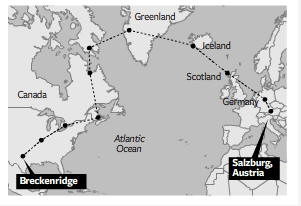
Full route |
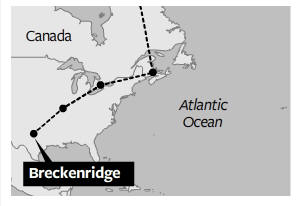
First leg |

Second leg |
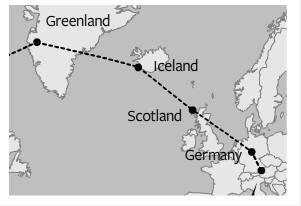
Third leg |
|
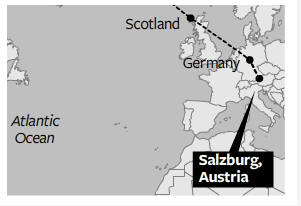
Final leg |
The P-38 Lightning's 7,500-mile flight
from Texas to Austria was expected to take
four days--25 hours and 5 minutes in the
air. The route was from Texas to
Canada to Greenland to Iceland to Scotland,
before hitting Germany and finally its new
home in Salzburg, Austria. |
CLOSE WINDOW